Typical duties
- Planned and corrective maintenance
- Fault finding and equipment testing
- Isolation and reinstatement under permit
- Record work and technical findings

Keep assets moving
Profiles connect formal trade competence with asset systems, hazardous-area experience, isolations and maintenance evidence.
Technician → senior/authorised technician → maintenance lead.
Training for this role
GWO technical learning supports wind tasks under appropriate supervision; it does not replace an electrical or mechanical trade foundation.
Check the six-week electrical, mechanical and instrument-and-control route for qualified technicians who can evidence ongoing current trade competence.
View provider guideReview electrical, mechanical, CompEx and GWO technical categories against the asset and trade.
View provider guideExplore GWO BTT, bolt tightening and related role-specific categories.
View provider guideRole pathway guide
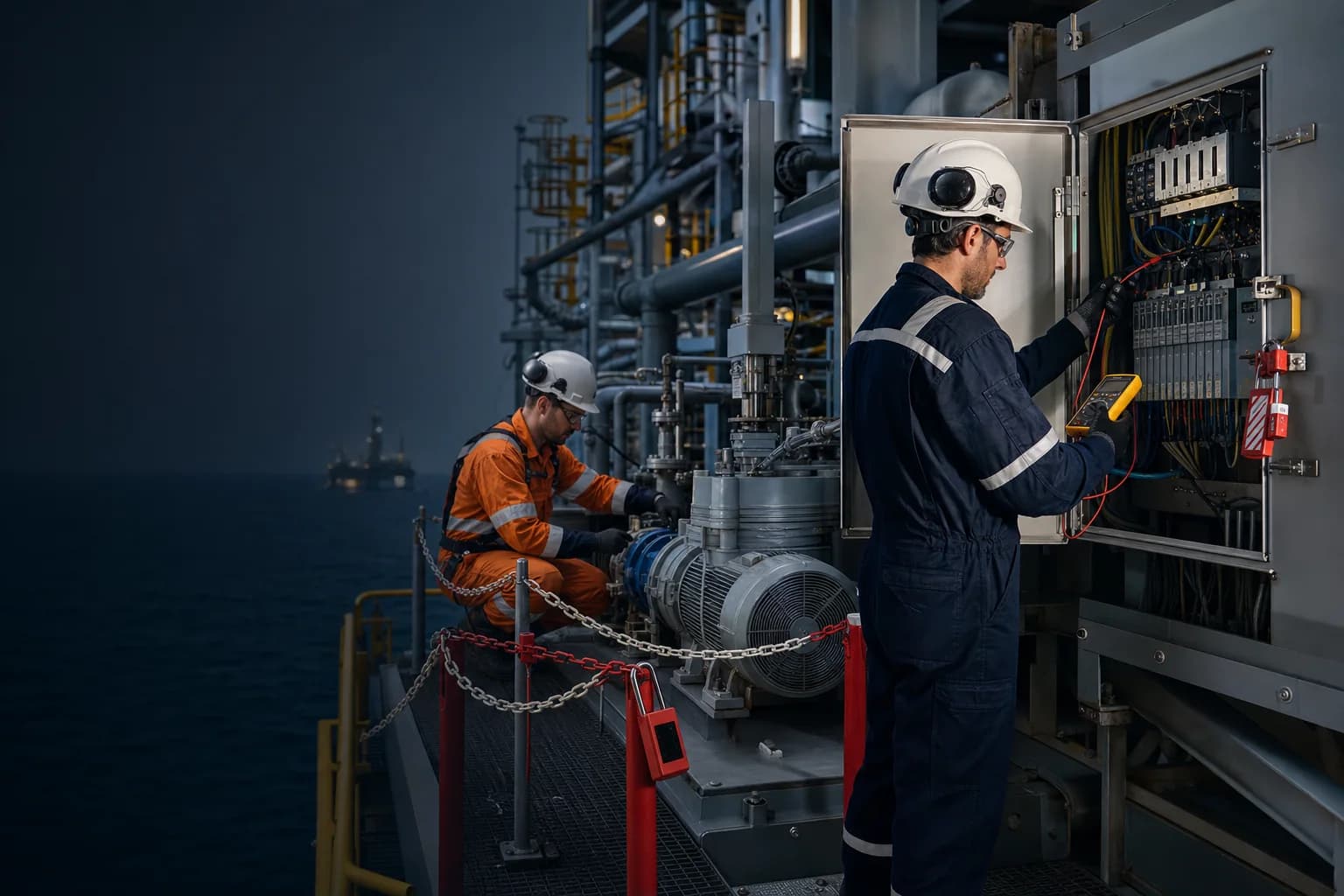
Electrical and mechanical technicians maintain safety-critical rotating, process, power and control equipment. Employers look for formal trade competence supported by fault-finding, isolation and planned-maintenance experience.
The most useful profile identifies systems and authorisations precisely: hazardous-area equipment, HV or LV work, turbines, generators, pumps, hydraulics, CMMS platforms and the boundaries of the candidate’s authority.
Maintenance may be routine, breakdown-driven or concentrated into shutdown campaigns. Technicians work under permits, isolations and reinstatement controls, sometimes in noisy, confined or hazardous areas.
Certificate names, numbers, issuing bodies, dates and files must agree. Offshore Personnel records expiry and review status, but the employer and certificate issuer decide whether evidence is accepted for a particular assignment.
Never alter documents or describe supervised exposure as independent competence. Accurate profiles are easier to assess and safer to mobilise.
Common questions
Requirements vary by employer, asset and jurisdiction. These answers explain the recruitment approach and the evidence employers commonly assess.
No. It is relevant where work involves hazardous-area equipment or the client specification requires it. The exact unit and currency must match the role.
Transfer is possible where trade competence and equipment experience match, but sector-specific safety, hazardous-area and asset requirements may differ.
Include trade qualifications, systems and equipment maintained, fault-finding responsibility, permit and isolation duties, authorisations and measurable project experience.